








A healthy smile plays an important role, and affordable dental insurance is a key aspect of ensuring quality care. However, insurance companies have some limitations. For example, missing tooth at the time of concluding the contract, excluding the wisdom teeth, it won't cause any problems finding a company, but absence of 2 or more teeth requires a special approach and the search for special packages. Not all insurance companies conclude contracts in this case or offer packages with non-standard conditions.
In addition, state health insurance covers only a portion of prosthetics and only basic options, such as metal crowns and bridges.
We have handpicked the best offers on the market, even if you are missing a few teeth:
What the statutory health fund pays
The payment from the fund is called Festzuschuss and is tied to the diagnosis, not to the treatment. The fund decides which option counts as standard for your case — Regelversorgung — and pays a share of its cost: 60 % without a Bonusheft, 70 % after five years and 75 % after ten.
Whatever you choose next — ceramic instead of metal or an implant instead of a bridge — the amount from the fund does not change. Everything above the standard you pay yourself.
| A case | Standard treatment | 60 % | 70 % | 75 % |
|---|---|---|---|---|
| Crown on a back tooth | 398,39 € | 239,03 € | 278,87 € | 298,79 € |
| Bridge when one tooth is missing | 921,60 € | 552,96 € | 645,12 € | 691,20 € |
| When several teeth are missing | — | 571,29 € | 666,51 € | 714,11 € |
| Full denture, upper jaw | — | 576,44 € | 672,52 € | 720,56 € |
| Full denture, lower jaw | — | 617,72 € | 720,68 € | 772,16 € |
The amounts apply from 1 January 2026 — they rose by 4.78 % against 2025.
Calculate your own share
The subsidy is calculated from the standard treatment for your diagnosis, not from the amount in the cost estimate. That is why your own share is bigger for an implant or ceramics. For an implant the fund pays the same as for a bridge — that is the standard when one tooth is missing.
It is exactly this share that dental insurance covers. How fully depends on the tariff and on the limits of the first years.
Find a tariffThree treatment options — and why this matters
| Treatment option | What is this | What the fund pays |
|---|---|---|
| Regelversorgung | The standard for your diagnosis | 60 / 70 / 75 % of the standard |
| Gleichartige Versorgung | Standard plus an upgrade — for example a ceramic veneer | the same amount; the extra is entirely yours |
| Andersartige Versorgung | A fundamentally different solution — an implant instead of a bridge | the same amount; the bill is fully private |
From 2027 the fund will pay less
The GKV-Beitragssatzstabilisierungsgesetz was passed on 10 July 2026. From 1 January 2027 the Festzuschuss shares fall:
| Base | until 31 December 2026 | from 1 January 2027 |
|---|---|---|
| Without a Bonusheft | 60 % | 50 % |
| Bonusheft, 5 years | 70 % | 60 % |
| Bonusheft, 10 years | 75 % | 65 % |
| Härtefall | 100 % | 100 %, unchanged |
In money the difference looks like this: on a bridge at 60 % it is 552.96 € instead of 460.80 €, about 92 € in favour of those whose plan was approved in 2026. On a crown it is about 40 €.
The same law raises co-payments for prescriptions and other services by 50 % from 2027: instead of 5–10 € it will be 7.50–15 €. The income-based exemption limits — 1 % and 2 % of annual gross household income — remain.
Bonusheft: how to reach 70 or 75 %
The Bonusheft is a booklet in which the dentist stamps each preventive check-up. Adults need one check-up per calendar year, teenagers aged 12–17 need two, one in each half-year. Only the years before the year of treatment count.
- Five years without a gap — 70 % instead of 60 %.
- Ten years — 75 %.
- 2020 counts automatically for everyone, no application needed: the pandemic concession has not been withdrawn.
- One gap is allowed only in years six to ten. A gap in the first five years drops the bonus back to 60 %.
- A stamp can be added retrospectively if the appointment actually took place.
- Since 15 February 2025 the Bonusheft is also kept in the electronic patient record (ePA). The paper version remains valid.
Härtefall: when the fund pays everything
On a low income the fund covers standard treatment in full. The limits are derived from the Bezugsgröße and change every January; in 2026 this is the monthly grosshousehold income:
| Household | Limit 2026 |
|---|---|
| One person | 1.582,00 € |
| Plus one family member | 2.175,25 € |
| Plus a second | 2.570,75 € |
| Plus a third | 2.966,25 € |
| Each further person | +395,50 € |
Härtefall applies without an income check to anyone living on Grundsicherungsgeld, Sozialhilfe under SGB XII, Grundsicherung im Alter, BAföG, and to those in an institution paid for by the Sozialamt.
If the income is slightly above the limit, a sliding rule applies: you pay no more than three times the amount by which you exceed it. At an income of 1,640 € the excess is 58 €, so your share will not exceed 174 €.
What it costs and what you pay
| Treatment | Price | Fund pays | Your share |
|---|---|---|---|
| Metal crown, standard | 398 € | 239–299 € | 100–159 € |
| Porcelain-fused-to-metal crown | 500–900 € | 239–299 € | 200–660 € |
| All-ceramic or zirconia crown | 700–1.600 € | 239–299 € | 400–1.360 € |
| Three-unit bridge, standard | 922 € | 553–691 € | 230–369 € |
| Ceramic or zirconia bridge | 1.400–3.000 € | 553–691 € | 710–2.450 € |
| Partial denture | 600–1.500 € | by diagnosis | 350–1.300 € |
| Full denture, one jaw | 500–1.600 € | 576–773 € | 0–800 € |
| Implant with a crown | from 2500 € | 239–691 € | from 1.800 € |
| Bone grafting | +500–3.200 € | 0 € | entirely yours |
Before treatment the dentist draws up a Heil- und Kostenplan and submits it to the fund. The plan is valid for six months. You are entitled to a free second opinion and may ask for three quotes — standard, mid-range and premium.
Which tariff covers your share
Below are the tariffs that cover your share. The conditions depend on how many teeth are already missing, so the blocks are split by situation.
No missing teeth
If you are planning dental prosthetics in the next 2-3 years (you have a problem tooth or suspect you will soon need an implant), then choose UKV, their tariffs have a maximum cover limit for prosthetics in the first 3 years.
If there are no plans for dental prosthetics in the next couple of years, then we recommend Allianz, as a company with the best value-for-money tariff.
Plan: MeinZahnschutz 100
from 29,88 €
a month at age 35
Tariff: ZahnPRIVAT 100
from 30,05 €
a month at age 35
Tariff: Zahn Premium
from 26,15 €
a month at age 35
Two years — 2500 €
Three years — 4000 €
Four years — no limits
1–2 years — 3000 €
1-3 years — 6000 €
After 4 years — no limits
1 year — 1500 €
1–2 years — 3000 €
1-3 years — 4500 €
1-4 years - €6,000
From Year 5 — no limits
- 100% if GKV is involved, otherwise 80%
- up to €150 once every 2 years
- up to €200 once every 2 years
- up to €200 every 2 years
- 2 years
- 2 years
- 2 years
Tariff: Zahn Premium
from 26,15 €
a month at age 35
1–2 years — 3000 €
1-3 years — 4500 €
1-4 years — 6000 €
After Year 5 — no limits
- 100% if GKV is involved, otherwise 80%
- up to €200 every 2 years
Fillings made of high-quality materials
Root canal treatment
Periodontitis treatment
Minimum contract period
- 2 years
One tooth is missing
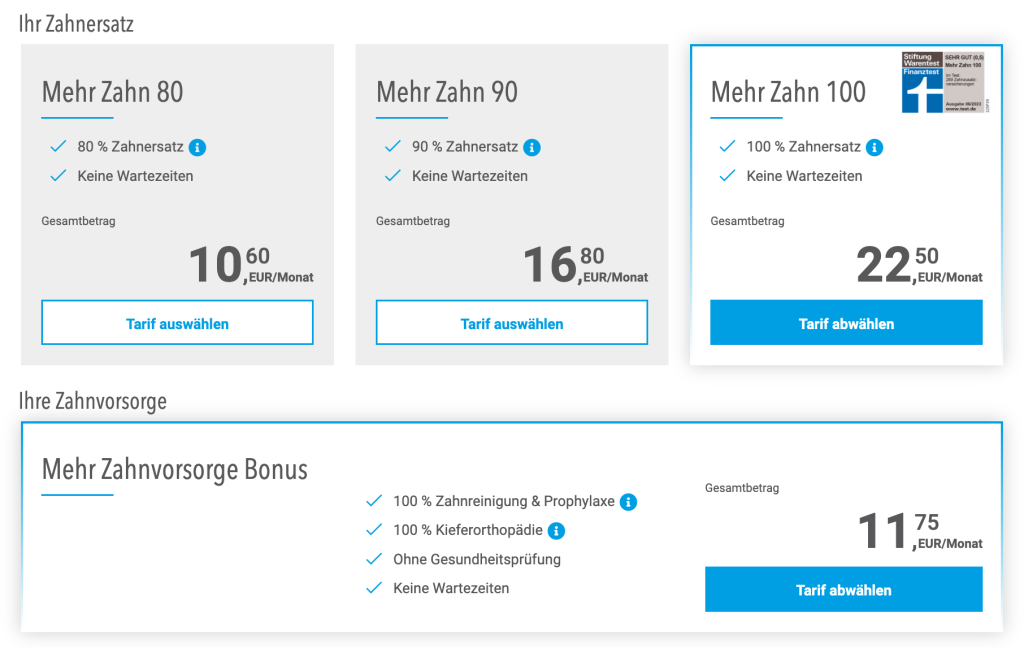
If a single tooth is missing, we recommend considering the tariffs from Barmenia, as 1 missing tooth does not affect the insurance company's payment limit in any way.
Barmenia tariffs consist of two independent parts, which means two separate maximum cover limits:
1. Mehr Zahn 80, 90 or 100% — the section relating to prosthetics, categorised according to the percentage of the cost of prosthetic treatment covered (implants, crowns, bridges, veneers and ceramic inlays).
2. Better dental care — check-ups, treatment, fillings using quality materials, professional tartar removal.
For full service, we recommend choosing both parts. However, you can also choose just Part 1 or Part 2.
Plan: MeinZahnschutz 100
from 29,88 €
a month at age 35
Tariff: Zahn Premium
from 26,15 €
a month at age 35
Tariff: ZahnGesund 100
from 37,90 €
a month at age 35
Allowance for a missing tooth
+25% added to the cost of the policy
Allowance for a missing tooth
+25% added to the cost of the policy
Allowance for a missing tooth
No
Two years — 2500 €
Three years — 4000 €
Four years — no limits
1 year — 1500 €
1–2 years — 3000 €
1-3 years — 4500 €
1-4 years - €6,000
From Year 5 — no limits
1–2 years — 3000 €
1-3 years — 4500 €
1-4 years — 6000 €
After Year 5 — no limits
- 100% if GKV is involved, otherwise 80%
- up to €200 a year
- up to €150 once every 2 years
- up to €200 every 2 years
Minimum contract period
- 2 years
- 2 years
- 2 years
Tariff: ZahnGesund 100
from 37,90 €
a month at age 35
Allowance for a missing tooth
No
1–2 years — 3000 €
1-3 years — 4500 €
1-4 years — 6000 €
After Year 5 — no limits
- up to €200 a year
- up to €200 every 2 years
Fillings made of high-quality materials
Root canal treatment
Minimum contract period
- 2 years
Two or three teeth are missing
Allianz Due to two missing teeth, the cost of insurance will increase by +50%, but the cover will remain the same.
The proposal can also be considered Signal Iduna. They charge an extra €5 for each missing tooth. The cover limit for missing teeth will be no more than €1,000 each.
Plan: MeinZahnschutz 100
from 29,88 €
a month at age 35
Tariff: Zahn Exclusive
from 36,10 €
a month at age 35
Tariff: Exclusive-Tarif CEZE
from 37,01 €
a month at age 35
- +50% to the cost of the policy
Two years — 2500 €
Three years — 4000 €
Four years — no limits
- +€10, up to €1,000 for implantation
Two years — 3000 €
Three years — 4500 €
Four years — 6000 €
Five years — no limits
The first year is 750 €
Two years — 1500 €
Three years — 2250 €
Four years — 3000 €
After Year 5 – no limits
- +75% added to the cost of the policy
Two years — 2500 €
Three years — 4000 €
Four years — no limits
- +€15, up to €1,000 for implantation
Two years — 3000 €
Three years — 4500 €
Four years — 6000 €
Five years — no limits
The first year is 750 €
Two years — 1500 €
Three years — 2250 €
Four years — 3000 €
After Year 5 – no limits
- up to €150 once every 2 years
Minimum contract period
- 2 years
- up to €300 once every 2 years
- 2 years
- up to €250 a year
- up to €250 a year
- 2 years
Tariff: Exclusive-Tarif CEZE
from 37,01 €
a month at age 35
The first year is 750 €
Two years — 1500 €
Three years — 2250 €
Four years — 3000 €
After Year 5 – no limits
The first year is 750 €
Two years — 1500 €
Three years — 2250 €
Four years — 3000 €
After Year 5 – no limits
- up to €250 a year
- up to €250 a year
- 2 years
More than three teeth are missing
If more than three teeth are missing, the majority of companies will refuse to conclude a contract, but we have found several companies without such restrictions.
Rate: Komfort 100
from 33,00 €
a month at age 35
Conditions:
Known missing teeth (without limit on number) at the time of concluding the insurance policy the company will not pay, only new problems.
- 1 calendar year up to €1000
- from 1 to 2 calendar years up to €2,000
- from 1 to 3 calendar years up to €3,000
- from the 1st to the 4th calendar year up to €4,000
- from the 5th calendar year without restrictions
Tariff: Exklusiv-Tarif CEZE
from 37,01 €
a month at age 35
Conditions:
Does not cover previously recommended or started treatment/prosthetics. There is limited cover in the absence of 2-4 teeth:
- 1 calendar year up to €750
- from 1 to 2 calendar years up to €1500
- from 1 to 3 calendar years up to €2,250
- from the 1st to the 4th calendar year up to €3000
- from the 5th calendar year without restrictions
It is not possible to conclude a contract in the absence of more than 4 teeth.
Tariff: Exklusiv
Conditions:
The dental treatment contract with the insurance company DFV can be concluded with any number of missing teeth, but their treatment or replacement will not be insured. There are no extra charges for missing teeth.
- 1 calendar year up to €1750
- from 1 to 2 calendar years up to €3500
- from 1 to 3 calendar years up to €5,250
- from 1 to 4 calendar years up to €7,000
- From the 5th calendar year without restrictions
Increase in state insurance payments for prosthetics
Compulsory medical insurance covers only a fixed amount for prosthetics, the size of which depends on the medical report.
The KDT plan from DKV and the Zahnersatz Sofort plan from ERGO make everything simpler: regardless of the level of cover approved by your health insurance provider, the amount will be doubled — often up to 100% of the reimbursable costs, no questions about health and missing teeth. This allows you to control costs and protect yourself against major financial risks with reasonable insurance premiums.
Tariff: KDT
Conditions:
Dental crown and denture services are insured — for example, bridges, dentures, implants, including restoration, materials and laboratory costs.
Doubling of the fixed payment based on diagnosis within the framework of compulsory medical insurance.
Waiting time — 8 months.
No questions about health and missing teeth.
Initiated prosthetics and prosthetics of known missing teeth company won't pay.
From 50 years old €12.00/month
Tariff: Zahnersatz Sofort
Conditions:
The cover extends to treatment using dentures, started for 6 months before the insurance policy comes into effect and ongoing at the time the insurance policy becomes effective.
Doubling of the fixed payment based on diagnosis within the framework of compulsory medical insurance.
No waiting time
The maximum reimbursement amount in the first year of insurance is 1,000 euros and €2,000 for the first two years of insurance combined. At the end of the second year of insurance without restriction.
From 50 years old €12.00/month
Tariff: Zahnersatz x2
Conditions:
Applies to recommended treatment, but not one that has been started or already calculated.
Doubling of the fixed payment based on diagnosis within the framework of compulsory medical insurance.
Waiting time — 6 months
No health questions, but no more than 2 missing teeth.
Maximum compensation amounts:
1 year — €250
1-2 years — €500
1–3 years – €750
From the age of 4 — without restriction.
Calculation for 35 years
When it is too late to take out cover
Dental insurance pays for what did not exist when the contract was signed. Hence three rules that people learn about too late.
After the Heil- und Kostenplan it is too late
Once the dentist has recorded that treatment is needed, it counts as recommended (angeratene Behandlung) and is excluded from cover. That is why the contract is signed before the appointment, not after.
There are ways out of this rule. At UKV the question about recommended treatment is limited to the last two years: if the diagnosis or recommendation is older, a contract is still possible. There are also tariffs that deliberately exclude problems already known but cover in full everything that arises later — for someone with one old problem and otherwise healthy teeth this is a workable option. We select the specific tariff for the situation.
No waiting period does not mean immediate payout
Many tariffs come without a Wartezeit — the contract is active straight away. But almost all have a Summenbegrenzung: a cap on payouts in the first years. Typically 1,000–1,500 € in the first year, 2,000–3,000 € over two, 3,000–4,500 € over three, with full cover from the fourth or fifth year. "Without a waiting period" means the application is accepted, not that the full amount will be paid.
The fewer teeth, the pricier and harder the contract
A tooth counts as missing if it is absent and has not been replaced. Wisdom teeth, gaps that have already closed by themselves, and teeth with a crown, bridge or implant do not count. One missing tooth is accepted by most companies without a surcharge, for the second and third they charge extra, and above three or four they often decline. Answer honestly: a wrong answer in the application voids cover under the whole contract.
Frequently asked questions
How much does the fund pay for a crown in 2026?
239.03 € without a Bonusheft, 278.87 € after five years and 298.79 € after ten — these are the 60, 70 and 75 % shares of a standard treatment costing 398.39 €. If the crown costs more than the standard, you pay the difference.
Why did the fund pay so little for an implant?
The payment is tied to the diagnosis, not the treatment. When one tooth is missing, the standard is a bridge, and the fund pays a share of its cost — 552.96 € at 60 %. Choosing an implant for 3,000 € does not change the amount.
What changes from 2027?
The shares drop from 60/70/75 % to 50/60/65 %. The previous shares are kept if the fund approved the Heil- und Kostenplan before 1 January 2027. Härtefall does not change.
How many years of Bonusheft are needed?
Five consecutive years give 70 %, ten give 75 %. Only the years before the year of treatment count. 2020 is credited automatically.
I lost my Bonusheft, what now?
Ask the practice to restore the records: stamps can be added retrospectively if the appointments actually took place and are in the patient file.
Who qualifies for Härtefall?
Anyone whose monthly gross household income is no higher than 1,582 € for one person and 2,175.25 € for two, and anyone receiving Grundsicherungsgeld, Sozialhilfe, Grundsicherung im Alter or BAföG. Only standard treatment is covered.
What if the income is slightly above the Härtefall limit?
A sliding rule applies: your share will not exceed three times the amount by which you are over. At an income of 1,640 € and a limit of 1,582 € the maximum is 174 €.
Can I take out cover once treatment has been prescribed?
As a rule no: recommended treatment is excluded from cover. There are exceptions — at UKV the question is limited to the last two years, and some tariffs cover only what arises after the contract is signed.
What is a Summenbegrenzung?
A cap on payouts in the first years of the contract: usually 1,000–1,500 € in the first year and 3,000–4,500 € over three. It is not the same as a Wartezeit — the contract may be active immediately and the cap still applies.
How many missing teeth are accepted when signing a contract?
One — almost everywhere without a surcharge. Two or three — with a surcharge on the premium. More than three or four is accepted only by selected tariffs. Wisdom teeth and teeth already replaced do not count.
This material is for general information and does not replace individual advice.
You can find out more about supplementary dental insurance in our general article Zahnzusatzversicherung
Do you need advice?
Fill in the form and we will answer all your questions and help you arrange supplemental dental insurance.
If you have any further questions, you can always contact us:
By email: [email protected]
On Telegram: t.me/Finber_support
-
Minimum pension in Germany: why there is none and what is paid instead
-
Direktversicherung in Germany: What Is Deducted from the Payout
-
Orphan's Pension in Germany 2026 - Waisenrente Rules
-
Occupational pensions for employers: what a company in Germany must do
-
Betriebsrente: the employer pension in Germany