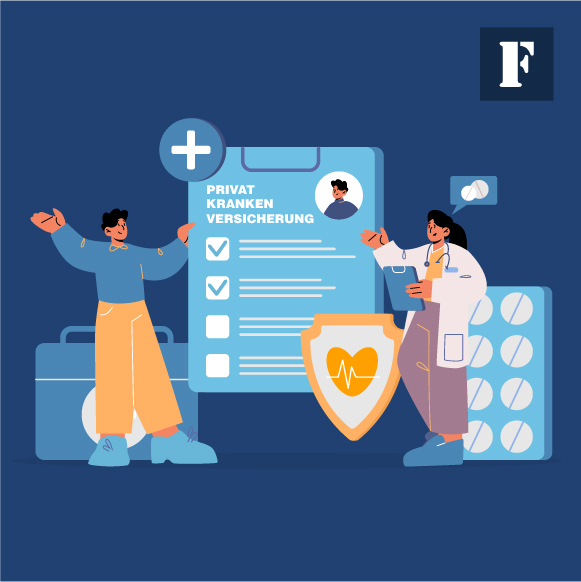
Privatkrankenversicherung or private health insurance (PKV) in Germany is one of the two main types of health insurance available to residents of Germany, alongside public health insurance (GKV). This article is intended for those who want to learn more about the advantages and disadvantages of PKV, how it differs from GKV, and who might be a suitable candidate for PKV. If you have any questions, please feel free to contact us for a consultation or submit an application.
Unlike the state GKV, the contribution here does not depend on income, but on age, state of health, the services chosen and the tariff.
PKV can be a cost-effective solution for high-earning employees, entrepreneurs, civil servants and certain family situations. However, it is not suitable for everyone: it is particularly important to assess the costs for a spouse and children, the risks in old age and the possibility of returning to the GKV in advance.





In a nutshell: who is PKV suitable for?
PKV is often more suitable
- Employees with an income above the Jahresarbeitsentgeltgrenze (annual earnings threshold)
- Self-employed / freelancers with a steady income
- Officials
- young and healthy customers
- customers who value high-quality medical services
PKV requires caution
- families with multiple children
- people on an irregular income
- people with a serious medical history
- those planning to return quickly to the GKV
- those who base their choices solely on price
- after 55, returning to the GKV is almost impossible (§ 6 Abs. 3a SGB V)
- a separate premium for your spouse and each child; in the GKV they can be insured free of charge (§ 10 SGB V). In my view, for couples without children under 12 this advantage of the GKV shrinks from 2028: the member will pay a surcharge of 2.5 % of their income for a spouse (§ 242b SGB V), which on €5,000 a month comes to €125. Children stay free
All articles about private health insurance in Germany:
What is private health insurance?
Private health insurance is a form of health insurance in which premiums are determined on the basis of individual factors, such as the policyholder’s age at the start of the contract, state of health and scope of cover. It covers a wide range of medical services, which often go beyond what is offered through the GKV.
The main advantages of PKV:
- Broad range of cover: PKV often includes more medical services than GKV.
- Quick access to doctors and medical services: With private health insurance (PKV), patients can gain quick access to doctors and short-notice appointments.
- Policy customisation: PKV policies can be tailored to the individual needs of the policyholder.
Main disadvantages of PKV:
- Higher insurance premiums: Premiums under the PKV are usually higher than under the GKV, particularly for pensioners and people with chronic illnesses.
- Risk of refusal: As PKV is based on individual risk, insurers may refuse cover on the grounds of a person’s state of health.
- Payment arrangements: PKV patients may be required to pay for medical services up front and then claim reimbursement from their insurer.
Private health insurance vs public health insurance: the main difference
| Question | GKV | PKV |
|---|---|---|
| What does the contribution depend on? | on income | on age, health, tariff |
| Children | often free of charge via the Familienversicherung (family insurance) | separate contribution for each child |
| Spouse with no income | may be free under the Familienversicherung; from 2028, +2.5 % of the member’s income unless there are children under 12 in the household | separate contribution |
| Services | depend on the law and the Krankenkasse (statutory health insurer) | depend on the contract |
| Doctor | principle of benefits in kind | Kostenerstattung (cost reimbursement): invoice first, then reimbursement |
| In old age | the contribution depends on income/pension | the contribution depends on the tariff and on how costs develop |
What private health insurance costs in Germany in 2026
There is no single price for PKV and there cannot be one: the premium is calculated for the individual. But three figures for 2026 are set by law, and they give you a starting point instead of guesswork.
Three figures that do not depend on the insurer
| Figure | 2026 | Legal basis |
|---|---|---|
| Income threshold for an employee to move into PKV (Versicherungspflichtgrenze, also called JAEG) | €77,400 a year, i.e. €6,450 a month | § 6 Abs. 1 Nr. 1 SGB V |
| Premium cap in the basic tariff (Basistarif) | €1,017.18 a month | § 152 Abs. 3 VAG |
| Maximum employer subsidy towards PKV | €508.59 for health cover + €104.63 for long-term care cover | § 257 Abs. 2 SGB V, § 61 SGB XI |
Where €1,017.18 comes from: the general rate of statutory health insurance in 2026 is 14.6 % plus the average supplementary rate of 2.9 % under § 242a SGB V, giving 17.5 % of €5,812.50: €848.62 plus €168.56. Exactly that amount serves as the cap for the Basistarif, and half of it as the maximum employer subsidy.
The €77,400 threshold does not work the way people think
If your salary is above the threshold from the first day of a new job, there is no compulsory insurance from the start, and you can choose PKV straight away (§ 6 Abs. 1 Nr. 1 SGB V). This is often the case for professionals who move to Germany on a high salary.
Crossing the threshold mid-year does not give you access to PKV from that moment. Compulsory insurance ends only at the end of the calendar year, and only if your earnings also exceed the next threshold that takes effect on 1 January (§ 6 Abs. 4 SGB V).
This will become obvious in 2027: according to the draft published by the Federal Ministry of Labour (BMAS) on 21 September 2026, the threshold will rise to 84 150 € — roughly 8.7 % in a single year. Someone earning €79,000 in 2026 has cleared this year’s threshold but falls short of the 2027 one, and therefore stays in the statutory Krankenkasse. Before making plans around PKV, compare your income not with today’s limit but with the one that will apply from next January. For people who are already privately insured on 31 December 2026, the draft sets a separate 2027 threshold of €80,550. The overall rise includes a one-off increase of €3,600, which does not apply to them.
The threshold does not apply at all to the self-employed, freelancers and civil servants — they may take out PKV at any income. What such a contract actually covers and what determines the range of benefits is examined separately: what private health insurance includes.
The market average premium and why it tells you little
According to the PKV-Verband, in 2024 adults without Beihilfe paid an average of €559 a month, and in no age group did the average exceed €650. Premiums rose on 1 January 2026 for roughly 60 % of the insured, and the average increase for them was about 13 %. Between 2006 and 2026, premium income per insured person grew by an average of 3.4 % a year.
That average says almost nothing about your case. PKV covers 8.79 million fully insured people of all ages, and the average also includes contracts concluded twenty years ago on different terms. Between a healthy 30-year-old employee and a 55-year-old self-employed person with full cover the difference is several-fold, and no average shows it.
What actually determines your premium: your age when the contract is concluded, your state of health at entry, the range of benefits chosen and the size of the excess (Selbstbeteiligung). Income plays no part — that is the main difference from the statutory Krankenkasse.
Why premiums rise and what cushions them
A PKV premium does not rise because you have grown older. Age is priced in from the outset; the premium is recalculated when actual treatment costs diverge from those assumed in the tariff. When medicine gets more expensive, the tariff does too — for the entire age group at once.
The system has its own counterweight built in. Under § 149 VAG every insured person pays a mandatory surcharge of 10 % of the gross premium — from the year after your 21st birthday up to and including the year in which you turn 60. The money goes into the ageing reserve (Alterungsrückstellung) and works for your own premium: from 65 it offsets premium increases, from 80 it reduces the premium (§ 150 Abs. 3 VAG).
If the premium becomes unaffordable
Leaving PKV after 55 is virtually impossible, but there are three lawful ways out inside the system, and they are rarely mentioned.
- Switching tariff with your own insurer (§ 204 VVG). You may require a transfer into any comparable tariff of the same company, with your accumulated ageing reserve credited. There is no health check if the new tariff offers the same or fewer benefits; for additional benefits the insurer may assess the risk and impose a surcharge, an exclusion or a waiting period (Wartezeit). This is the most underrated instrument: it needs nobody’s consent except your own application.
- The basic tariff (Basistarif, § 152 VAG). The range of benefits is comparable to the statutory Krankenkasse, and by law the premium may not exceed €1,017.18 a month (2026). The insurer is obliged to accept you; refusal on health grounds is not possible.
- Half the premium in case of need. If paying the premium would cause Hilfebedürftigkeit (need for social assistance) under SGB II or SGB XII — or it already exists — the basic-tariff premium is halved for the whole period of need (§ 152 Abs. 4 VAG). In 2026 that is €508.59 a month.
Long-term care cover is counted separately: in the private system it is compulsory and taken out under its own contract, but its premium is capped too — after 5 years of prior insurance (Vorversicherungszeit) it may not exceed the maximum contribution to the soziale Pflegeversicherung (statutory long-term care insurance), and children are covered free of charge on the same conditions as in the statutory system (§ 110 Abs. 3 SGB XI).
The figures on this page were verified on 1 October 2026 against the 2026 ordinance on social insurance parameters, the texts of the VAG, VVG, SGB V and SGB XI, and PKV-Verband publications.
It is impossible to give an exact figure — the premium is calculated individually. But as a rough guide, here are the amounts my clients most often come across (2026 figures, before the employer subsidy):
- A young, healthy employee aged 28-35 – roughly 350–650 € per month.
- Self-employed, 35-45 years old, good tariff - approximately 450–700 € per month.
- A policy with a high excess (Selbstbeteiligung) is noticeably cheaper, but you cover a portion of the costs yourself.
For context: according to the PKV-Verband, premiums rose on 1 January 2026 for roughly 60 % of the insured, and the average increase for them was about 13 %.
For employees, the employer covers roughly half of the contribution (Arbeitgeberzuschuss), so the amount you pay out of your own pocket is lower. The figures depend heavily on age, health and the range of services in the contract—which is why the actual calculation is always individual.
Who is eligible for private health insurance?
To be eligible for PKV, you need to meet certain criteria. You either need to be self-employed or have a sufficiently high income (above a certain threshold, which is set every year. In 2026, this is an income of €77,400 or more). In addition, international students and guests can take advantage of PKV.
The threshold for switching to PKV from 01/01/2027 is expected to be around €84,000.
Recently a 31-year-old IT specialist came to me: an employee with a salary well above the switching threshold. He is healthy, with no chronic conditions and no children. For him, PKV turned out to be more cost-effective than GKV: he received a wider range of services for comparable money. But I immediately discussed the flip side with him as well—if he starts a family in a few years, there will be a separate contribution for each child. It is important to work such things out in advance, not after signing the contract.
When is the best time to take out private medical insurance?
The right time to switch to PKV depends on your situation. It can be a good idea if you are young, healthy and earn enough to cover the cost of PKV contributions. It is important to remember that returning to GKV can be difficult after switching to PKV, and after 55 years of age it is impossible. If moving to PKV is not right for you, some of the benefits of a private patient are available through cover for Wahlleistungen (optional hospital services) without changing insurance systems: a single room and treatment by the head physician without changing insurance systems.
Another case: a family, two small children, and the husband’s income was just above the threshold. He was tempted by the attractive conditions of private health insurance (PKV) and almost signed the contract. We sat down, did the maths – the contribution for him plus separate contributions for his wife with no income of her own and for both children – and the picture changed. In statutory health insurance (GKV), the children and spouse would be insured for free via family insurance (Familienversicherung). From 2028 nothing changes for this family either: as long as the youngest child is under 12, no surcharge applies for his wife. In his situation, I didn’t recommend rushing to switch. Sometimes the best advice is “not yet”.
It is important not to confuse the Jahresarbeitsentgeltgrenze and the Beitragsbemessungsgrenze. The first determines whether an employee can leave compulsory GKV and switch to PKV. The second determines up to which income threshold GKV contributions are calculated.
Transfer of a portion of contributions to a non-working spouse or children – Arbeitgeberzuschuss zur PKV
In Germany, there is the option to optimise health insurance contributions taking your family situation into account. If you are on private health insurance (PKV) and your monthly contributions are lower than those you would pay in the statutory system (GKV), you can transfer these savings to the insurance contract of your non-working spouse or children. This allows you to use funds efficiently and provides additional cover for your family. This is a distinctive feature of PKV compared to GKV, where such an option may not be available.
Most of the time, if you have one child and your spouse has their own health insurance, your total contributions to a PKV will be lower than to the statutory health insurance, and the number of covered services will be significantly higher.
Example: in 2026 the maximum employer subsidy is €508.59 towards health cover plus €104.63 towards long-term care cover (§ 257 Abs. 2 SGB V, § 61 SGB XI). If the employee’s PKV costs €400, part of the remaining allowance may be used for a spouse’s or children’s PKV — provided the conditions are met.
Debunking the myth: Returning from private to statutory health insurance
There is a common myth that after switching to private health insurance (PKV), returning to public health insurance (GKV) is difficult or even impossible. In reality, there are several pathways that can be used to return to the GKV system.
- Drop in income: if you are under 55, employed and your annual income falls below a certain threshold, you can return to the GKV system. This threshold changes every year, so you should check for current information. In 2026, this threshold is €77,400.
- Employment: if you become an employee with an income below a certain threshold before the age of 55, you will also become eligible to return to the GKV system.
-
Obtaining unemployed status and unemployment benefit can also be a way back into the statutory health insurance system (GKV) after private health insurance (PKV).
If you become unemployed, you can return to the GKV system as long as you are under 55 and receive Arbeitslosengeld I (unemployment benefit), not Grundsicherungsgeld (basic income support). This is because the GKV system is generally more affordable for those in an unstable financial situation or with a low income, which is often the case when receiving unemployment benefit.
I have more than once had people around the age of 50 come to me with the question: “I want to go back to the GKV, how do I do that?” And often I have to disappoint them: after 55, the door back is almost closed. That is why I always suggest viewing a switch to the PKV as a decision for 15 to 20 years ahead, and not for a couple of years. We calculate in advance both the rise in contributions in old age and the role of reserves (Altersrückstellungen) – so that there are no nasty surprises later.
Short PKV Glossary
| Term | What does it mean in simple terms |
|---|---|
| PKV | private medical insurance |
| GKV | state health insurance |
| Annual Earnings Threshold for Compulsory Health Insurance | income threshold above which employees can switch to private health insurance |
| contribution ceiling | maximum income threshold for GKV contributions |
| Selbstbeteiligung | excess - the part of a claim that the client pays themselves |
| premium refund | refund of a portion of contributions if no claims are submitted |
| Altersrückstellungen | internal tariff reserves for smoothing out old-age contributions |
| Basic tariff | special PKV tariff capped at the GKV maximum contribution level |
Frequently asked questions about PKV
What is the main difference between PKV and GKV?
Who can switch to PKV?
Can you switch back from private health insurance (PKV) to statutory health insurance (GKV)?
Why do private health insurance (PKV) contributions increase with age?
How are doctor’s visits paid for in PKV?

Specialises in health and personal insurance in Germany, helps navigate the choice between PKV and GKV, and selects a tariff tailored to the client’s specific situation.
Sources and legal basis
The information in the article is based on current German legislation (SGB V, GewO, VAG). Below are links to the official legislative texts and relevant organisations:
- §5 SGB V - compulsory health insurance (Versicherungspflicht)
- §6 SGB V – Exemption from compulsory insurance and the income threshold (Versicherungsfreiheit)
- §257 SGB V - employer contribution to private health insurance (PKV) premiums (Arbeitgeberzuschuss)
- §34d GewO - insurance intermediary licence (Versicherungsvermittler)
- §152 VAG - PKV basic tariff (Basistarif)
- PKV-Verband - Association of Private Health Insurers of Germany
Private health insurance in Germany offers numerous benefits and will most often be more cost-effective than public health insurance. Switching to private health insurance should take into account your plans for at least the next 10-20 years. Before making a decision, you should carefully consider your needs and financial situation.
Do you need advice?
Video: Private health insurance in Germany: pros, cons, pitfalls
How private health insurance (PKV — private Krankenversicherung) works in Germany and what the consequences of this choice are. We analyse the key points: payment for treatment, contribution structure, employer subsidies, out-of-pocket expenses, refunds, as well as the impact of family and children. Personal experience and important details worth knowing.
This section contains a video from YouTube. To watch it, click the button below. Doing so will share data with Google.
More informationReady to apply?
If you have any further questions, you can always contact us:
By email: [email protected]
On Telegram: t.me/Finberdebot
More articles about private health insurance in Germany

Myths about private health insurance in Germany
Medical insurance is an important part of taking care of your health and wellbeing. However, when it comes to

What is included in private health insurance in Germany
Private health insurance (Private Krankenversicherung, PKV) in Germany offers a wider choice and individual services compared to public insurance. When choosing such insurance, it is important to understand what exactly it includes and how it covers various aspects of medical care. In this article, we will examine which services are included in the private insurance package, from outpatient and inpatient treatment to dental care and preventive measures.

Switching from private to state health insurance in Germany, and vice versa
Changing health insurance in Germany: when you can switch from private (PKV) to statutory (GKV) and back – conditions, age limits and income thresholds.




-
Mahnverfahren: how to recover a debt in Germany without a lawsuit or a court hearing
-
Deutsche Bahn Familienticket for 99,99 € is now permanent: conditions and catches
-
What changes in Germany in October 2026
-
Dental insurance before the year ends: when the “short first year” really works
-
Methods of earning pension points — Entgeltpunkte