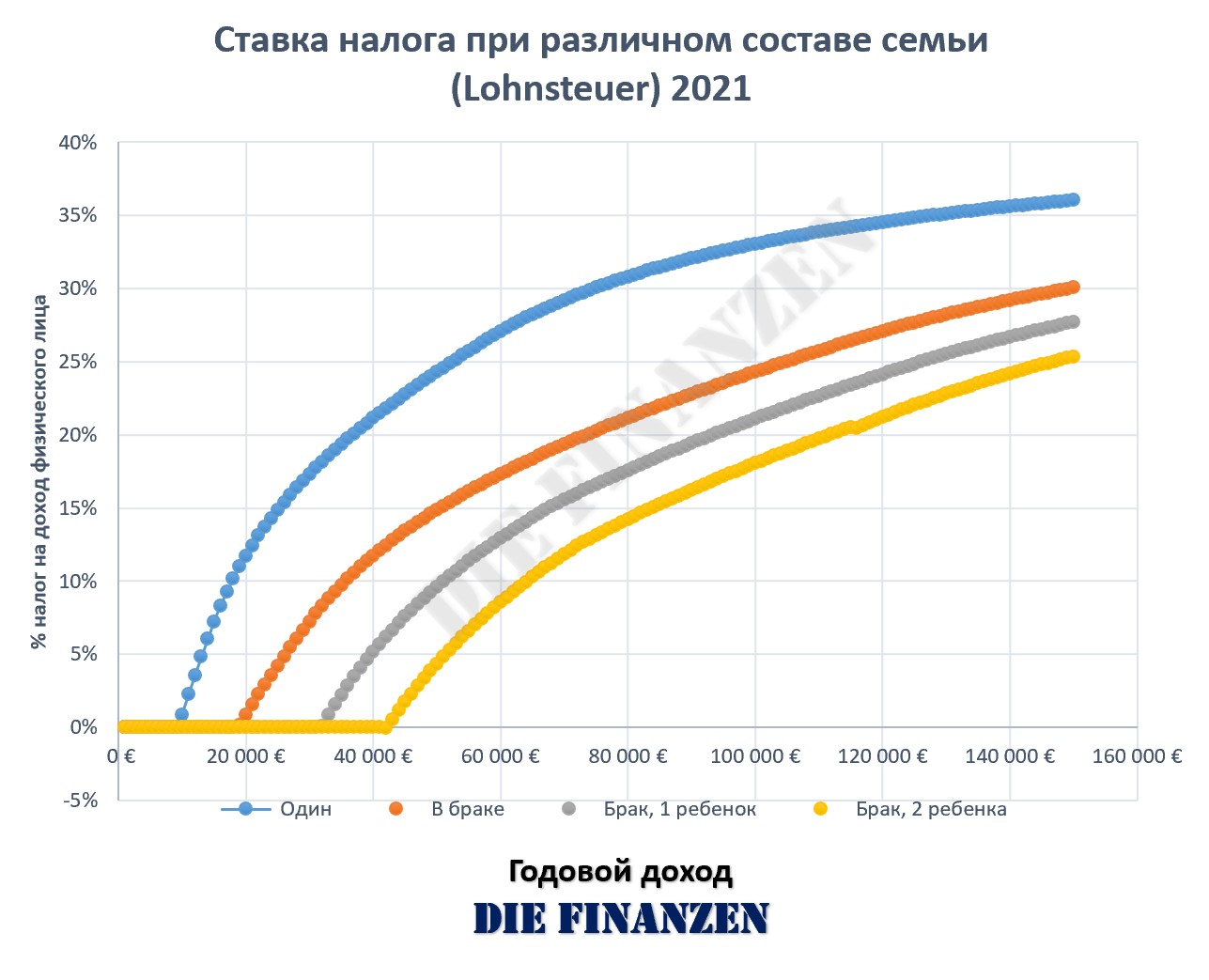
What does a salary deduction consist of?

Two different things are deducted from the gross salary, and they are often confused. Taxes are the Lohnsteuer, plus church tax if you belong to a church, plus the remnants of the Solidaritätszuschlag for high earners. Social security contributions are separate: pension, health, care and unemployment insurance.

That is why «they take half» is a feeling, rather than the actual rate. Half is made up of tax and social contributions, and the second half of the social contributions is paid for you by your employer.

Social security contributions from German salaries in 2026: pension, health, long-term care and unemployment insurance with employee and employer shares

Bets for 2026

Income tax in Germany is progressive: it is not the entire salary as a whole that increases, but each successive chunk of income.

  • Up to €12,348 per year, there is no tax at all. that is the Grundfreibetrag. For married couples filing jointly, it is €24,696.
  • The next bet starts at 14 % and steadily increases alongside income.
  • 42 % — from €69,879 taxable income. For married couples — from €139,758.
  • 45 % — from €277,826.

There is an important nuance here, which is precisely why the myth about huge taxes has arisen. The 42 % rate is not applied to the entire salary, but only to the portion of it that exceeds the threshold. The average rate across the whole income is always significantly lower than the top rate.

And all this is calculated not from gross income, but from taxable income — after deducting social security contributions, work-related expenses, insurance, and other special expenses (Sonderausgaben).

Two examples

Both earn the same, but pay differently — the whole difference is in their marital status.

Example 1. Ivan Mustermann earns €60,000 a year. He has no family or children and is in tax class I.

Example 2. Mikhail Schmidt earns the same €60,000 a year. He has a wife who does not work and two children—tax class III.

In summary: Ivan, who is not married, pays around 27 % — approximately €16,200 a year. Mikhail, the head of the household, pays around 9 %, or roughly €5,100. The difference is more than €11,000 a year, even though they earn the same salary.

The figures are rounded and given as orders of magnitude: the exact amount depends on the church tax, federal state, insurance contributions and deductions. Calculate your own using the Federal Ministry of Finance's official calculator.

Of course, there are plenty of nuances, but the general approach is just like that. Well, are the taxes really that high?

Have any questions? Write to us and we'll look into your situation.

Why is the amount deducted per month different from the annual amount?

The tax class doesn't change your annual tax. It only changes how much your employer withholds each month in advance. The final amount is calculated once a year in your tax return.

Hence two typical situations.

  • Combination of III and V in spouses. Take-home pay per month is higher, but a year-end bonus is often paid out. The combination of IV and IV with a tax factor distributes deductions more evenly.
  • Class VI. It is used if the employer has not been given the Steuer-ID or if it is a second job. Deductions are at the maximum rate, and overpayments are only refunded via a tax return — more details about the number itself in the breakdown Tax ID and tax number.

Therefore, submitting a tax return almost always makes sense: the average refund in Germany amounts to hundreds of euros, and for those with a long commute or who paid tuition fees, it can be thousands.

Frequently asked questions

From what salary does tax start in Germany?

From an annual taxable income above €12,348 in 2026. Anything below is tax-free.

Is it true that with a 42 %, you end up giving away almost half your salary?

No. 42 % applies only to the portion of income above €69,879. The average rate across the entire salary remains significantly lower.

Why does a colleague with the same take-home pay have more?

Most likely a different tax bracket: he is married, and his spouse earns less or doesn't work. The annual tax might end up being comparable – the difference will show up in the tax return.

Is it compulsory for an employee to submit a tax return?

Not always, but often advantageous. The obligation arises, for example, in tax class VI, with a combination of classes III and V, with income apart from salary, and when receiving benefits.

About the author. Valeriy Melekh, Finber. Insurance broker with licence under § 34d para. 1 GewO and real estate finance broker under § 34i GewO, IHK Rhein-Neckar. Over 20 years of practice, around 6,000 clients.

Sources. Tariff brackets and Grundfreibetrag for 2026 – § 32a EStG, the text of the law. Personal account — official calculator of the Federal Ministry of Finance.

Relevance. Data verified in August 2026. Tariff thresholds are reviewed almost annually – the page is updated with every change.

This material is for informational purposes only and does not constitute tax advice.

2 responses

  1. My husband and I filed our tax return with the tax office and had to pay extra; I paid it all, but my husband asked for a separate return for himself. Are married couples allowed to file separate returns? Thanks in advance.

    1. Good afternoon.
      Yes, married couples are entitled to submit separate tax returns.
      You would be best advised to seek advice from a tax specialist.

Leave a Reply

Your email address will not be published. Required fields are marked *