- Updated:
- 07.10.2026
In Germany, with its highly developed social security system, understanding the types of insurance and knowing how to make use of supplementary insurance is an important element of financial planning.
And although health insurance (gesetzliche Krankenversicherung or private Krankenversicherung) and motor insurance (Kfz) are part of the compulsory basic set, supplementary insurance helps you close the gaps and feel secure about the future.
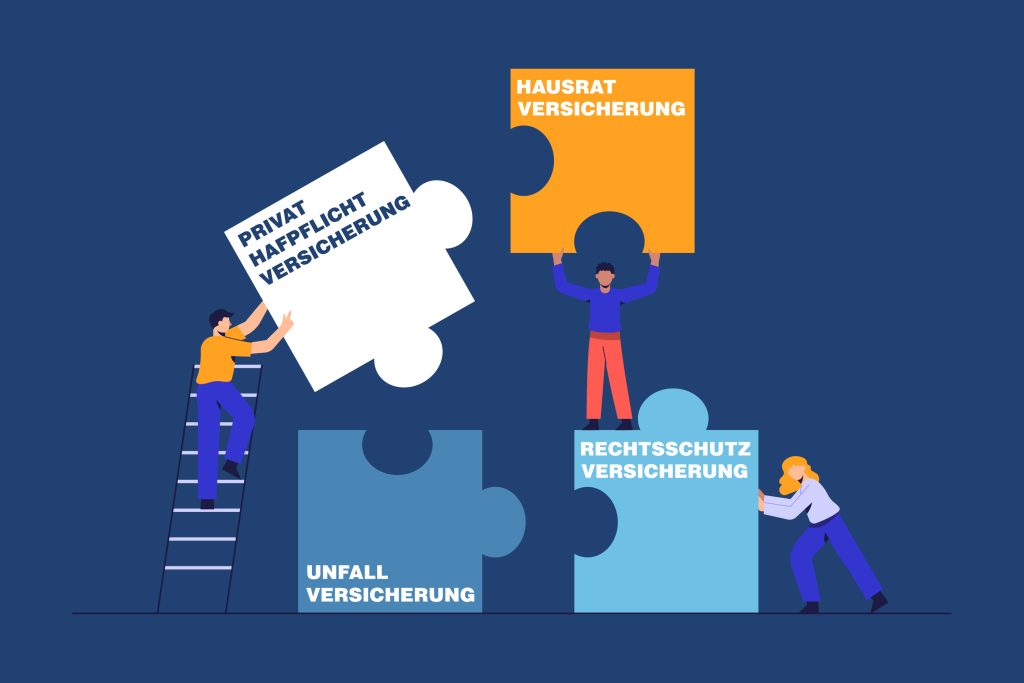
In this article we have looked at seven essential supplementary insurances for Germany, which are particularly relevant for immigrants, families with children, as well as if you work and rent accommodation. These insurances will help avoid major expenses, legal disputes and sudden financial losses.
The seven most important supplementary insurances:
Privathaftpflichtversicherung – third-party liability insurance.
This is basic insurance in Germany. It protects you if you or your child accidentally cause damage to someone else’s property or health and they are claiming compensation. This insurance is a must-have for everyone, especially if there are children in the family. Important exception: damage caused by an e-scooter is not covered by the Privathaftpflicht — for that you need a separate e-scooter insurance policy.
Examples of situations where this policy might come in handy
- You accidentally broke your friend’s new phone at a party
- You have lost the key to the main entrance door of the apartment building and a lock replacement is required. The average cost is around €2,000.
- You don’t notice the cyclist and he gets into an accident and injures his leg. Insurance will pay for the expensive treatment
- In the supermarket car park, you hit another car with your trolley and damaged it. Insurance will cover the repairs.
- As a result of a short circuit in your flat, a fire breaks out and damages the neighbouring flat. Insurance will pay for the neighbours’ repairs.
Additional options
- Professional liability
- Damage related to favours. For example, if you drop a friend’s laptop while helping them move house for free.
Cases when the policy does not work
- Damage caused to yourself or persons insured under the same policy as you (family members)
- Wilful damage or unlawful damage
If it seems like there is too much information and it’s easy to get confused, — write to us and we will answer your questions in detail.
Berufsunfähigkeitsversicherung (BU) – insurance against occupational incapacity due to illness, injury, accident, etc.
If a serious illness, injury or accident means you are no longer able to work in your profession, this insurance will protect you against loss of income.
Occupational disability insurance (Berufsunfähigkeitsversicherung, or BU for short) guarantees a regular monthly pension if your current state of health prevents you from continuing to work in your profession. This insurance is particularly useful for sole breadwinners whose loss of income would have a negative impact on the family budget.
Which diseases most often lead to disability
- Mental and nervous disorders – 32%
- Diseases of the musculoskeletal system — 21%
- Cardiovascular diseases – 15%
- Cancer – 15%
- Accidents – 9%
- Other – 8%
Without this insurance, in the event of incapacity for work, state benefits amount to approximately 30% of income, and only if the person concerned is unable to work for more than three hours a day. BU covers up to 80% of salary. Standard payments start from €1,000/month.
Hausratversicherung – home contents insurance against fire, escape of water, storm, hail and burglary
This insurance will protect expensive furniture, the new television, and even the bicycle in the basement, should someone decide to steal them or a fire break out in the house. Under the terms of the policy, you will be paid compensation as for a brand-new sofa or appliances. You can additionally insure furniture belonging to the landlord. Even against your cat’s antics.
What can be insured under Hausratversicherung?
- Furniture
- Home appliances
- Money
- Clothing
- Valuables
- Electrical appliances
What can home contents be insured against?
- Against water, fire and explosion
- Against burglary
- Against hail, lightning and storms
Additional options
- Bicycle theft insurance
- Anti-theft protection while travelling
- Glass insurance
- Online protection against financial risks on the Internet
- Natural-hazard cover
Rechtsschutzversicherung — legal expenses insurance
Legal expenses insurance covers legal costs, consultations and pre-trial settlement if a complex situation arises. Often, a single letter from a lawyer is enough to resolve the issue.
Main sections of Rechtsschutzversicherung
Privatrechtsschutz (private legal protection) — disputes in private life
- Disputes with a neighbour over noise or an incorrectly installed fence
- Disputes with the seller over a faulty item and its return
- Divorce disputes are covered to a limited extent by legal expenses insurance
Berufsrechtsschutz (employment legal protection) — disputes with your employer
Professional legal protection can be useful both for the self-employed and for company employees.
- The employer is not providing a work reference
- No promotion in accordance with the agreement
- Unwarranted warning or disciplinary sanction
Verkehrsrechtsschutzversicherung (motor legal protection) — traffic disputes
- Argument with another road user
- Unlawful revocation of a driving licence
- Incorrectly issued penalty
Wohnungs- und Grundstücks-Rechtsschutz (property legal protection) — tenancy and housing disputes
Useful for both landlords and tenants.
- Eviction
- Increase or decrease in rent
- Damage to the property
Send us a request if you would like a quote for legal expenses insurance and advice on the next steps.
Unfallversicherung – accident insurance
Everyone is insured whilst at work. However, around 75% of all accidents happen to people outside of work. Whether it’s falling off a bike, twisting your ankle whilst on holiday with friends, or other mishaps — Unfallversicherung is there to help in all these situations.
Advantages of Unfallversicherung
- Payment of a lump sum
- Payment of a lifelong disability pension is possible
- Payment for search and rescue operations is possible
- Lump-sum payment to relatives in the event of death from an accident (even if death occurred within 2 years of the incident)
- Coverage of cosmetic and plastic surgery is possible if the accident affected the appearance
- Operates 24/7 worldwide
Who is it for?
- Sole traders
- For people with an active lifestyle and risky hobbies
- For people without work
Read more about accident insurance in our article.
Risikolebensversicherung – term life insurance
Fairly inexpensive policy, usually with a payout from €100,000. In the event of the insured person’s death, close relatives receive a substantial payout.
When you should consider this insurance:
- There are large loans or a mortgage that need to be paid off.
- You are the main breadwinner in the family.
- You want to make sure that if anything happens to you, your loved ones will be financially protected.
You can name any beneficiary — a family member or, for example, a charity.
Zahnzusatzversicherung – supplementary dental insurance
Dental treatment in Germany is an expensive business. Statutory health insurance covers only part of the costs, paying solely for necessary treatment and procedures.
Supplementary dental insurance covers modern treatments using high-tech, durable materials. If you need dental prosthetics, further treatment or orthodontic procedures, Zahnzusatzversicherung will cover most or all of the costs. That is why it is so important, especially as you get older.
We compared several insurance policies and set out our recommendations on choosing Zahnzusatzversicherung on this page:
Which insurances are compulsory by law in Germany
Before choosing among the seven described above, it helps to separate two categories. There are three core types of compulsory insurance, plus one group that is compulsory for certain professions. In addition, several federal states require dog owners to hold Hundehaftpflicht (dog owner’s liability insurance); in Lower Saxony this applies to every dog over six months old. You cannot get a hunting licence without Jagdhaftpflicht (hunting liability insurance), and employees are automatically covered by statutory social insurance. Everything else — including Privathaftpflicht, which is often called “compulsory” here — is legally voluntary.
1. Health insurance. § 193 Abs. 3 VVG (Insurance Contract Act) requires everyone with a place of residence in Germany to hold cover for outpatient and inpatient medical costs. The duty is tied to residence, not to citizenship and not to having a job. The excess under such a contract is capped at €5,000 per calendar year per person. How the Krankenkasse (statutory health insurer) works and what it costs is explained on the page statutory health insurance in Germany.
There is a sanction for a gap in cover, but it is not a fine. In private insurance a surcharge applies under § 193 Abs. 4 VVG: one monthly premium for every started month without cover, and from the sixth month one sixth of a premium for each further month. If the length of the gap cannot be established, the law assumes five years. With a Krankenkasse, the gap is closed by charging contributions retroactively, but § 256a SGB V (Social Code Book V) obliges the Kasse to reduce them to a concessionary rate and to waive late-payment surcharges in full. German law provides no administrative fine for having no health insurance.
2. Long-term care insurance (Pflegeversicherung). You do not buy it separately: under § 1 Abs. 2 SGB XI (Social Code Book XI) everyone insured with a Krankenkasse is included in the social Pflegeversicherung automatically, by operation of law. Those with private cover, however, must take out a private policy themselves — usually with the same insurer (§ 23 Abs. 1 SGB XI).
The 2026 rate is 3,6 %. There is a subtlety here that even specialist sites get wrong: § 55 Abs. 1 SGB XI still says 3.4 %, while the rate actually in force is set by a separate ordinance (PBAV 2025) and has been 3.6 % since 1 January 2025. Childless members aged 23 and over pay 0.6 points more, i.e. 4.2 %. For each child from the second to the fifth the rate falls by 0.25 points, until that child turns 25.
Saxony is a special case. The overall rate is the same, but under § 58 Abs. 3 SGB XI the employee pays one percentage point more than the employer: 2,3 % versus 1,3 % (not counting the surcharge for childless members). The reason is that Saxony is the only Land (federal state) that kept Buß- und Bettag (Day of Repentance and Prayer) as a public holiday. What Pflegeversicherung covers and how a Pflegegrad (care grade) is awarded is explained on the page long-term care insurance.
3. Motor third-party liability — but only if you own a vehicle. § 1 PflVG (Compulsory Insurance Act) requires the keeper of a vehicle regularly based in Germany to take out and maintain liability cover. The provision was rewritten by the law of 11 April 2024. The sanction for driving without it is not administrative: § 30 PflVG provides for up to one year’s imprisonment or a fine, and for negligence up to six months or 180 daily rates, while the vehicle itself may be confiscated.
4. Professional indemnity — compulsory not for everyone but for specific professions, with minimum sums set by law:
| Profession | Legal basis | Minimum per claim |
|---|---|---|
| Lawyer | § 51 Abs. 4 BRAO | 250 000 € |
| Tax adviser | § 52 DVStB | 250 000 € |
| Notary | § 19a Abs. 3 BNotO | 500 000 € |
| Auditor | § 54 Abs. 4 WPO | 1 000 000 € |
| Doctor contracted to the Krankenkassen | § 95e Abs. 2 SGB V | 3 000 000 € |
| MVZ (medical care centres) and practices with employed doctors | § 95e Abs. 5 SGB V | 5 000 000 € |
| Insurance intermediary | § 34d GewO + VersVermV | €1,564,610 (and €2,315,610 per year) |
One detail worth knowing when choosing a broker: the figures in the text of § 12 VersVermV (Insurance Mediation Ordinance) are out of date. It still states €1,276,000 and €1,919,000, whereas since 9 October 2024 the higher amounts from EU Regulation 2024/896 actually apply. Asking your broker for proof of a current policy is normal practice.
Not compulsory, but needed by almost everyone
Here it is more useful to show not one opinion but where the independent consumer organisations agree and where they disagree.
Everyone agrees on:
- Privathaftpflicht — Verbraucherzentrale Hamburg calls it one of the most important insurances there is, Stiftung Warentest counts it among the indispensable ones. Nobody disagrees.
- Berufsunfähigkeit — for everyone who lives on earned income.
- Wohngebäude (buildings insurance) together with natural-hazard cover — for property owners.
- Travel health insurance — if you travel abroad.
They disagree on:
- Hausratversicherung. The Verbraucherzentrale Bundesverband puts it among the indispensable ones, Verbraucherzentrale Hamburg says it depends on the situation, and Stiftung Warentest rates it important but not top three.
- Rechtsschutzversicherung. A direct contradiction: Stiftung Warentest considers it necessary, while Verbraucherzentrale Hamburg writes plainly that it is “kein Muss” (not a must) and puts it on the not-recommended list.
- Unfallversicherung. The Verbraucherzentrale itself plays down its importance: most cases of lost earning capacity are caused by illness rather than accident, so occupational disability cover addresses the risk far more broadly.
The practical conclusion: if the budget is tight, the order of purchase is set not by promotional lists but by which loss you could not cover yourself. We review the policies most often sold unnecessarily in a separate article: useless insurance policies in Germany.
Where to start after moving: the order of priority
The first weeks. Health insurance — compulsory from the first day of residence, and without it neither visa nor everyday matters can be settled. Pflegeversicherung is attached to it automatically and needs no separate step. If you have a car, motor liability cover comes before registration — without it the car will not be registered.
The first month. Privathaftpflicht. It is not legally required, costs €20 to €50 a year, and covers the one risk that can cost you everything: harm accidentally caused to another person. It is the sensible starting point for all voluntary cover.
The first six months. Berufsunfähigkeit, if you live on a salary or income from your own business. The earlier you take it, the cheaper it is and the fewer health questions arise. Hausrat — if the contents of your flat are worth a noticeable amount.
The first year and beyond. Rechtsschutz, Unfall, Zahnzusatz, Risikoleben — according to your situation, not “just in case”. Each of the seven policies is examined above; if you are unsure which of them is yours, look at which loss your savings would not cover.
What it costs per year
The figures below are reference points from public surveys, not offers. The exact premium depends on age, family composition, place of residence, occupation and the cover chosen.
| Insurance | Price range per year | Source and date |
|---|---|---|
| Privathaftpflicht | €20–50 depending on whether the tariff is for one person, a couple or a family | Finanztip, August 2026 |
| Unfallversicherung | €50–100; a separate child disability policy costs €100–400 | Finanztip, January 2026 |
| Hausratversicherung | there is no current public range for 2026; the sum insured is calculated from €650 per square metre of living space | Verbraucherzentrale, November 2025 |
| Rechtsschutzversicherung | in the most recent public survey a private + professional + traffic package cost €240–680 for a single person and €260–820 for a family | Finanztip, 2023 survey |
| Risikolebensversicherung | no range exists: the premium is calculated individually and is influenced most by smoking, then by age at entry, the sum insured and the term | Finanztip |
Two caveats on the figures. The Rechtsschutz range comes from a survey three years old — there is no newer public one, and the market has become more expensive since. And for Hausrat the spread between insurers for one and the same contract reached a factor of two, so comparing pays off here more than in other lines.
Conclusion: which insurance to choose in Germany?
If you want to put together the optimal combo, base it on your lifestyle:
- Family with children — Privathaftpflicht + Unfall + Zahnzusatz + Hausrat (with the “Glas” option for glass breakage)
- Working — Privathaftpflicht + BU + Rechtsschutz
- Tenants — Privathaftpflicht + Rechtsschutz
- Mortgage holders — Privathaftpflicht + Risikolebensversicherung + BU
The cost of insurance in Germany varies from €5 to €50+ a month depending on the type.
Frequently asked questions about supplementary insurance in Germany
What is supplementary insurance (Zusatzversicherung) in Germany?
The term refers to voluntary policies taken out on top of the compulsory ones. They protect against risks that neither health insurance nor motor third-party liability insurance covers: liability towards others, loss of the ability to work, legal costs, accidents, home contents, your life and dental treatment. In the narrow sense, Zusatzversicherung means supplementary health insurance on top of GKV (statutory health insurance): a private doctor, a single room in hospital, dental care.
Who needs additional insurance?
Additional insurance is recommended for those who want to protect themselves and their loved ones in the event of death or loss of working capacity, reduce personal expenses on dental care or alternative medicine, and also for those who enjoy risky hobbies.
Can you take out supplementary insurance (Zusatzversicherung) with statutory health insurance (GKV)?
Yes. Most such policies are designed specifically for those who are insured under the GKV and want to expand the range of medical services.
What types of Zusatzversicherung are there?
There are many different types of supplementary insurance in Germany. In 2026, the most essential ones are:
- Privathaftpflichtversicherung — Third-party liability insurance
- Berufsunfähigkeitsversicherung (BU) — Insurance against occupational disability
- Rechtsschutzversicherung — Legal Expenses Insurance
- Unfallversicherung — Accident Insurance
- Hausratversicherung — Home Contents Insurance
- Risikolebensversicherung — Term Life Insurance
- Zahnzusatzversicherung — Supplementary dental insurance
How do I choose the right Zahnzusatzversicherung?
Additional dental insurance will help avoid high expenses in the event of complex treatment, dental prosthetics or the need for orthodontic treatment.
We have compared several Zahnzusatzversicherung policies in a detailed expert article with recommendations and links.
Find out more about the main optional insurance policies in 2026 in our video.
This section contains a video from YouTube. To watch it, click the button below. Doing so will share data with Google.
More information



-
Mahnverfahren: how to recover a debt in Germany without a lawsuit or a court hearing
-
Deutsche Bahn Familienticket for 99,99 € is now permanent: conditions and catches
-
What changes in Germany in October 2026
-
Dental insurance before the year ends: when the “short first year” really works
-
Methods of earning pension points — Entgeltpunkte
We want to help as many people as possible manage their own finances with our recommendations. That is why our content is available free of charge online. We fund our extensive work using so-called affiliate links. We mark these links with an asterisk (*).
(*) meaning:
With our recommendations, we want to help as many people as possible look after their finances. We fund our work through affiliate links. We mark these links with an asterisk (*).