



ETF savings plan: how the accumulation plan works
ETF savings plan is an instruction to your broker: to debit a fixed amount every month or quarter and use it to buy units of a chosen fund. You set it up once — after that, everything happens automatically, including the purchase of fractional shares if you don't have enough money for a whole one.
The point is not to guess the right entry time, but rather not to look for it at all. With a fixed contribution amount, you buy more units when the market falls and fewer when it is expensive. This effect is called cost averaging: it does not increase returns on its own, but it removes the main risk for a private investor—putting everything in at once at the peak and selling at the bottom.
What an ETF is, how accumulating and distributing funds differ, and with which brokers to open an account have been covered on the page about ETFs and brokers.
An ETF savings plan builds up wealth without limits and without government support. If your goal is specifically a pension, compare it with a scheme where the government adds money to your contributions: state support for pension savings from 1 January 2027. The flip side is that the money is locked up until age 65.
How to set up a plan in five steps
- Open Depot — securities account with a broker or bank. Comparison of brokers and tax differences — in the ETF breakdown: brokers and taxes.
- Choose a fund. For a basic portfolio, a broad index is usually chosen: MSCI World, FTSE All-World or MSCI ACWI. Funds available for a Sparplan can be filtered at extraETF.
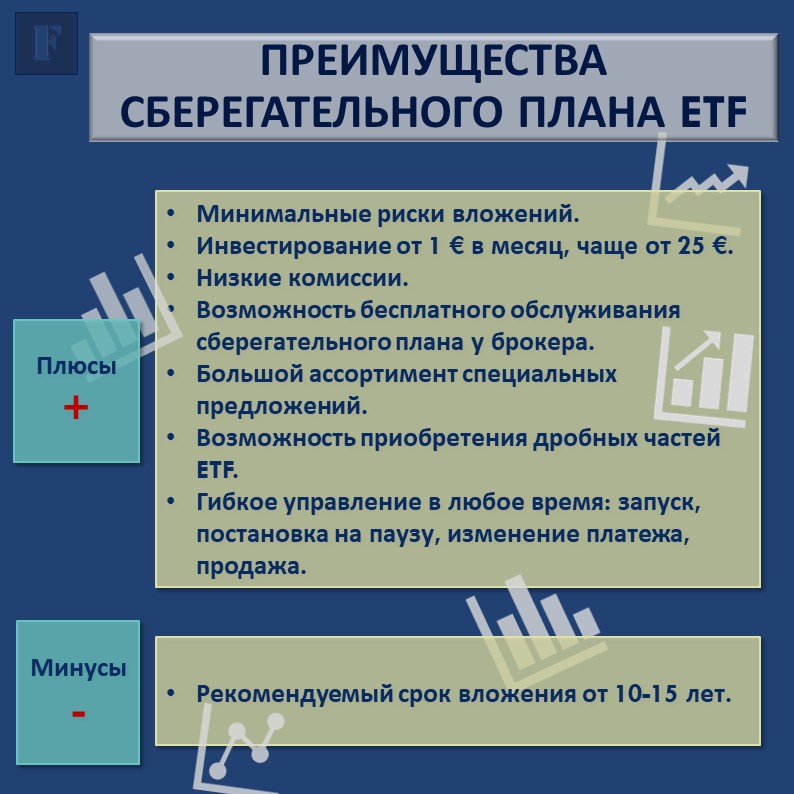
- Set the amount. With German brokers, the minimum contribution starts at €1–25 per month, with a typical starting amount of €50–100.
- Select interval — monthly, every two months or quarterly. Monthly is more common: it coincides with payday.
- Specify the due date. Usually the choice is the 1st, the 15th, or the last working day. The money must be in the current account the day before.
The plan can be paused, changed, or cancelled at any time. Unlike endowment insurance policies, it is not a binding contract.
What is the MSCI World
The MSCI World tracks large and mid-cap equities from 23 developed countries: the USA, Germany, Japan, the UK, Canada, Switzerland, France and others — around 1,300 companies. Emerging markets are not included; for those, the MSCI Emerging Markets is used, or alternatively the FTSE All-World or MSCI ACWI right away, where developed and emerging markets are already combined.
Important caveat: the US share of MSCI World exceeds two-thirds. «The whole world» here largely means the US market.
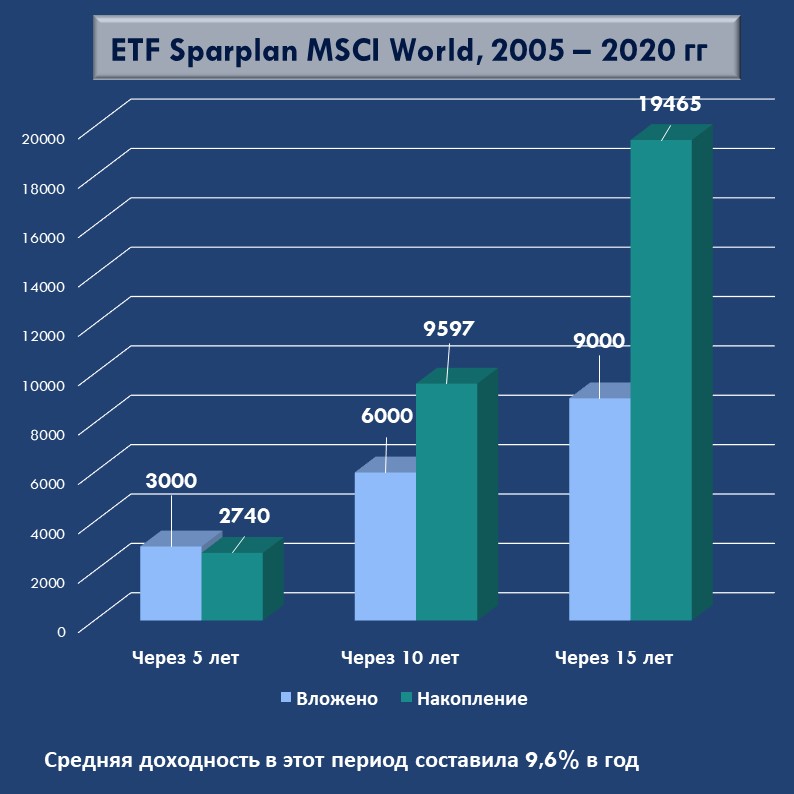
The chart shows what an investment plan tracking the MSCI World Index would have looked like with a monthly contribution of €50 over a fifteen-year period: despite the 2008 crisis occurring during this time, the trend was still one of steady growth. The average annual return over this period was around 9.6 %.
Such a figure should be treated with caution. This is the result of one specific window, which captured the longest bull market in US history. Over another fifteen-year period the result would be different, and on a five-year horizon, quite possibly negative.
Horizon, dynamisation and rebalancing
- Deadline. The sensible minimum is 10–15 years. Money that might be needed sooner should not be put into equity ETFs.
- Dynamisation. Many brokers are able to increase the contribution annually by a set percentage. The contribution grows along with your salary, and you don't have to remember to do it manually.
- Rebalancing. If there are multiple funds, the allocations drift apart over time. Rebalancing them is easier not by selling, but by directing new contributions into the lagging part: that way, no capital gains tax arises.
- What to do in a collapse. Nothing. A market fall while a plan is running means the next contribution buys more units. Stopping a plan during a slump is the most costly of typical mistakes.
Savings plan taxes
There is no separate tax on the Sparplan — the fund’s income is subject to tax: Abgeltungsteuer at 25 % plus the solidarity surcharge, totalling 26.375 %, with a partial exemption of 30 % for equity funds. As long as the annual profit does not exceed the Sparerpauschbetrag (€1,000 per person, €2,000 for married couples) and a Freistellungsauftrag has been submitted, no tax is withheld at all. For accumulation funds, the Vorabpauschale is deducted in January – a calculation with an example is provided taxes of a German investor.
A practical point: make sure there is available cash in your current account at the beginning of January. Otherwise, the broker will deduct the Vorabpauschale by selling some of the units.
Vermögenswirksame Leistungen: ETF from your employer
Many employers in Germany top up salaries up to €40 a month For savings, these are capital-forming benefits (Vermögenswirksame Leistungen). You can channel them into a ETF savings plan rather than just a building society savings contract (Bausparvertrag), which is the habitual practice.
On top of that, the state adds the Arbeitnehmersparzulage: 20 % on amounts up to €400 per year, meaning at most €80 a year. Condition: taxable income not exceeding 40.000 € per year for a single payer and 80.000 € in the case of joint tax returns for spouses, the thresholds were raised in 2024. The contract is designed for six years of contributions plus a one-year waiting period.
Whether your employer pays VL is shown in your employment contract, collective agreement or human resources department. Money that is not claimed simply isn't paid out.
Early start pension: savings plan for children from 2026
The government plans to top up 10 € a month for every child aged between 6 and 18 with their main place of residence in Germany. The money goes into an individual investment account, and the family can add their own contributions – up to 6,840 € a year. Income within the account is tax-free until retirement, and early withdrawal is not permitted.
The Federal Ministry of Finance bill was published on 22 July 2026, and its adoption is planned before the end of the year with retroactive effect from 1 January 2026. For now it is a bill, not a current law — the conditions might still change.
Frequently asked questions
Can the payment be skipped?
Yes. The plan can be paused and resumed in your account, and there are no penalties.
Once a month or once a quarter?
The difference in the final result is negligible. The monthly interval is psychologically more convenient and aligns better with the pay cheque.
How many funds are needed?
For a basic portfolio, one broad global fund is enough. It makes sense to get several when there is a deliberate reason to deviate from the market.
What happens when moving away from Germany?
The portfolio can usually be preserved, but the tax regime changes. This is a matter for a tax adviser, not for a DIY approach.
This material is for informational purposes only and does not constitute an individual investment recommendation, tax or legal advice. The value of securities may go up and down, and past performance is no guarantee of future results.
Any questions? Write and we will reply to you in detail.
Recent Posts
- Minimum pension in Germany: why there is none and what is paid instead
- Direktversicherung in Germany: What Is Deducted from the Payout
- Orphan's Pension in Germany 2026 - Waisenrente Rules
- Occupational pensions for employers: what a company in Germany must do
- Betriebsrente: the employer pension in Germany