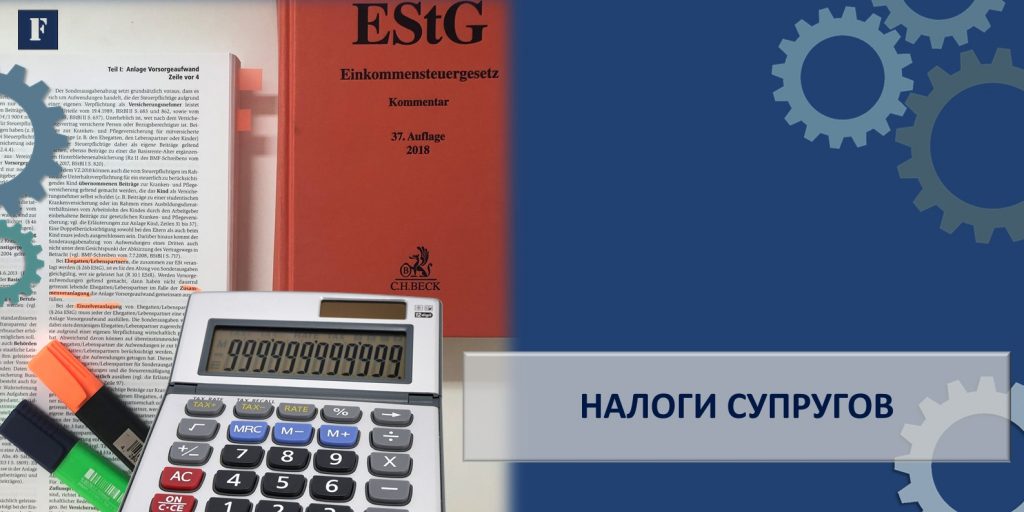
How married couples pay income tax in Germany
By default income tax is assessed individually: one taxpayer, one return. That applies above all to:
- 🚻 couples whose relationship is not officially registered
- 🚹 widows and widowers
- 🚺 the divorced
- 🚮 married couples who have permanently separated (dauernd getrennt lebend)
This is called Einzelveranlagung — individual assessment.
Conditions for a joint return
- 🔓 the marriage is officially registered (same-sex marriage too)
- 🔓 both spouses are tax residents of Germany (citizenship does not matter)
- 🔓 they do not live apart on a lasting basis
- 🔓 the conditions are met at the start of the calendar year or arise during it
So if the marriage took place in December, for that whole year you may choose either joint or individual assessment. The same goes for the year in which the spouses separated: if they lived together for at least one day that year, a joint return is still possible. For the year of the divorce, as a rule, it no longer is: a divorce is preceded by a year of separation (Trennungsjahr).
For a joint return, spouses fill in one form; with individual assessment, each of them files their own return. When a return comes from an officially married couple, the tax office assumes joint assessment by default — to switch to individual assessment you have to tick a particular box on the form.
What the difference is
When individual assessment is chosen, the income and deductions of each spouse are counted separately.
When joint assessment (Zusammenveranlagung) is chosen, the income and deductions of both are added up and halved, the tax is calculated on that half, and the result is multiplied by two. That is Ehegattensplitting.
What it is worth in 2026
The tax-free basic allowance (Grundfreibetrag) in 2026 is 12 348 € per person. For spouses filing jointly it doubles: 24 696 €. The tax-free allowance per child (Kinderfreibetrag together with the BEA-Freibetrag, for both parents) is €9,756.
The gain from splitting is greater the further apart the two incomes are. If both earn roughly the same, there is almost no difference — with a progressive scale there is nothing left to even out.
How to choose
Best of all is tax software that can calculate both variants — only then is the decision made on figures rather than by feel. From practice: one couple filed jointly in the year of their divorce and saved about 800 €; for another the calculation showed a difference of 1 € between separate and joint filing. It depends entirely on the individual case.
Separate from the filing method is your tax class — it decides how much is withheld from your salary each month, not the final tax for the year. And if you are filing a return for the first time, we have a walkthrough of how to file a tax return.
Any questions? Write to us and we will reply in detail.


Recent Posts
- What changes in Germany in November 2026
- Mahnverfahren: how to recover a debt in Germany without a lawsuit or a court hearing
- Deutsche Bahn Familienticket for 99,99 € is now permanent: conditions and catches
- What changes in Germany in October 2026
- Dental insurance before the year ends: when the “short first year” really works